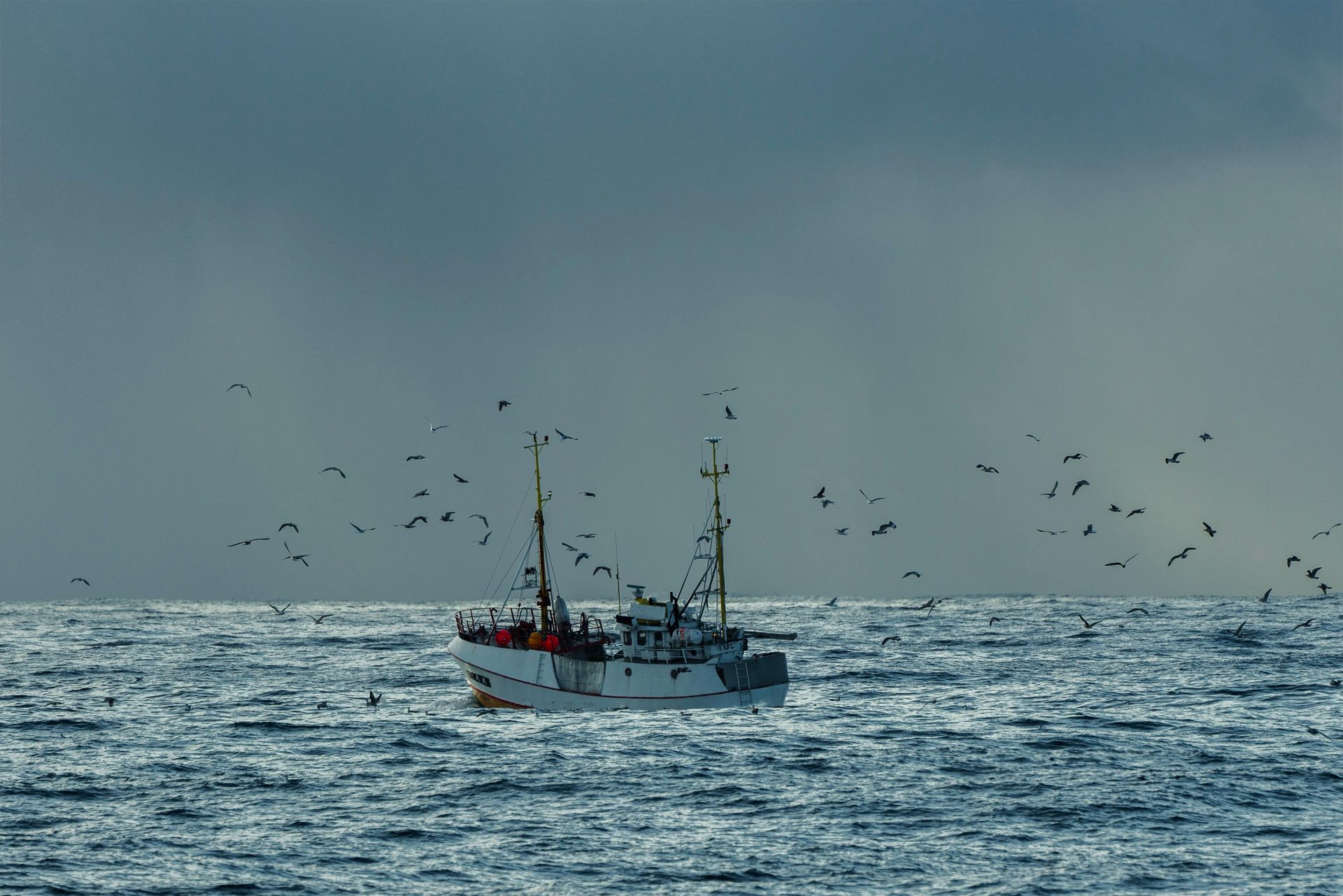
Environmental organizations appeal to EU court to invalidate fishing quotas due to Baltic herring stocks collapse
The Coalition Clean Baltic (CCB) network has recently submitted an application to the General Court of the European Union (GCEU) to invalidate the EU fisheries ministers' decision on the 2024 fishing quotas for the Baltic herring. CCB considers that the EU Council of Ministers violated existing fishing regulations and that they ignored and directly undermined other environmental legislation in place. Moreover, the Ministers do not take into account the precautionary principle, whether regarding the ecosystem's status or a coastal fishery that can no longer catch Baltic herring for human consumption.
Uppsala, 21 August 2024 - As late as a few months before the decisions on fishing quotas for 2024 were made for the Baltic Sea, the EU and its Member States had actively supported decisions on the protection of our seas on an international level. It was indeed proclaimed that the world's oceans outside national borders must now be protected. But apparently not our own inland Baltic Sea when it comes to fishing quotas.
The EU Commission proposed, in the light of alarming facts but also based on the rules the EU jointly decided to protect collapsing fish stocks, to completely close the targeted Baltic herring fishery primarily caught by large trawlers. Data published by ICES (the International Council for the Exploration of the Sea) indicated that even with zero fishing, stocks would not recover above the lowest reference level (see ICES advice on the Central Baltic herring stock, p3). In this particular scenario, there is a rule for how to act, which is of course to close the fishery. The ministers blatantly broke this rule when they instead decided that the permitted fishing in the Southern and Northern Baltic Sea should total over 100,000 tonnes, i.e. 100 million kilos!
During the winter, CCB requested the EU Council of Ministers to review its decision in the light of all applicable laws, i.e. not only the most obvious fisheries regulations but also the EU's and the countries' own environmental laws. When this request was rejected with the claim that nothing was incorrect in the Council’s decision, CCB decided to appeal it and ask the EU Court for an annulment of the Council's decision not to review the 2024 Baltic fish quota decision.
“We expect the court to agree with our arguments and concur that the Ministers broke the law. Of course, this does not mean that we will suddenly get the fish back. The central thing here is rather to stop the crazy circus of playing with our ecosystem in this way”, says Nils Höglund, marine and fisheries expert at CCB.
“It cannot be too much to ask that the Ministers act legally and take into account the needs of the ecosystem but also the needs of the small but important coastal fisheries. I think all citizens demand that the ministers live up to all the nice words they gleefully throw around at big conferences”, continues Nils Höglund.
If the court approves CCB´s request, it would affect how the Ministers can act in the future. It would set a precedent and clarify how the law should be interpreted in the light of setting fishing quotas not only in the Baltic Sea but across the EU. There is a big risk that the politicians aim to change the rules in order to soften the regulations, which has already partially started. However regardless of that, this court process is unfortunately necessary. Mikhail Durkin, Executive Secretary of the CCB concludes:
“Being forced to go to court is absolutely not something we want to do. Environmental policy must be created and implemented by elected politicians with the support of the people. However, when the people have been promised responsible actions, but see only action that is the total opposite of responsible and even illegal, we simply have to call it quits.”
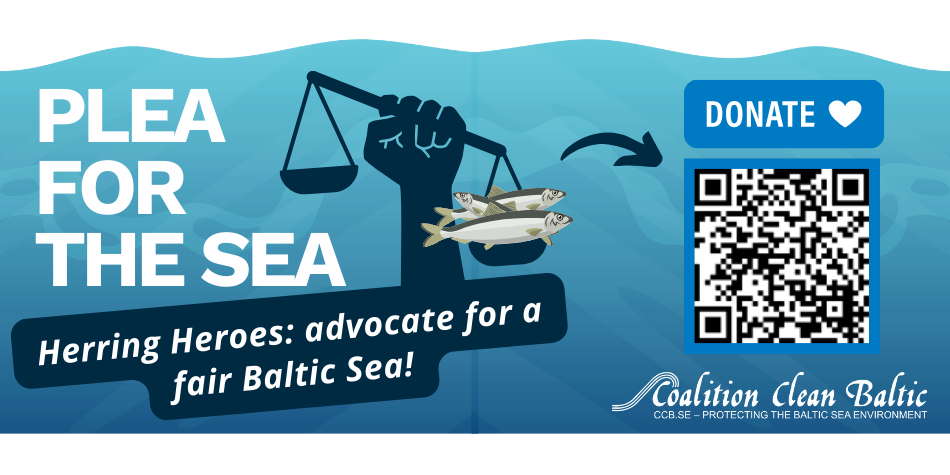
CCB welcomes all and any support to see this Court process through. It will be a long journey, but we can't do it alone – and for this reason we have launched the campaign “Plea for the Sea - Advocate for a Fair Baltic Sea!”. Your donation can help to support the legal case and to pressure policy-makers to follow the law and protect the Baltic Sea marine life.
Donate to be a Herring Hero here: https://www.ccb.se/plea-for-the-sea-herring-heroes-advocate-for-a-fair-baltic-sea
-END
The Swedish version of this PR is available
here.
Note to editors:
Coalition Clean Baltic (CCB) – Is a politically independent, non-profit association, which unites 27 NGOs, with over 1 500 000 members in all countries around the Baltic Sea. The main goal of CCB is to promote the protection and improvement of the Baltic Sea environment and its natural resources for present and future generations. More info at: www.ccb.se
CCB original complaint and request for internal review contains most of the arguments now raised with the EU Court. That file and all annexes are not yet available publically.
- CCB request for internal review to the Council: https://data.consilium.europa.eu/doc/document/ST-5738-2024-INIT/en/pdf
- Council reply to the request: https://data.consilium.europa.eu/doc/document/ST-9350-2024-INIT/en/pdf
- CCBs earlier statement from January about the case: https://www.ccb.se/ngos-request-legal-scrutiny-of-ministers-decision-to-continue-fishing-on-baltic-herring-stocks-in-decline
Contact:
Nils Höglund, CCB Marine and Fisheries Policy Officer:
nils.hoglund@ccb.se
Mikhail Durkin, CCB Executive Secretary:
mikhail.durkin@ccb.se