NGOs call on decision makers to do right by the Baltic Sea ecosystem – new scientific advice shows that Baltic fish stocks are still under stress

CCB • June 3, 2024

On Friday, 31 May, the International Council for the Exploration of the Seas (ICES) published its scientific advice on how much fish can be caught in the Baltic Sea next year [1]. The numbers show that the Baltic Sea ecosystem and fish stocks remain in severe distress and that even the cuts in catches that have been made over the past years are not enough to bring stocks back to healthy levels. NGOs and small-scale fishermen alike call for a drastic overhaul of the current fisheries management that should put the health of the Baltic Sea ecosystem at its centre.
June 3, 2024 – The decline of fish population in the Baltic Sea has been well documented. It started with salmon and cod over 20 years ago, then the herring stocks started to dwindle until now even the previously abundant sprat stock has entered a free fall. The cause behind this is that fishing pressure is still too high, each year more is taken then can be replenished, leading the ecosystem in a downward spiral.


The main reason for this is that the political choice has been made to set fishing quotas around the lowest level of fish abundance that will avert collapse. This goes against both the EU law as well as common sense, the law stipulates that quota levels should aim for strong fish stocks that can sustain a fishery without being at risk. For example, the scientific advice for central Baltic herring shows that we are far from the target level for a resilient fish stock and there is only a slim probability that this level will be reached in 2026.


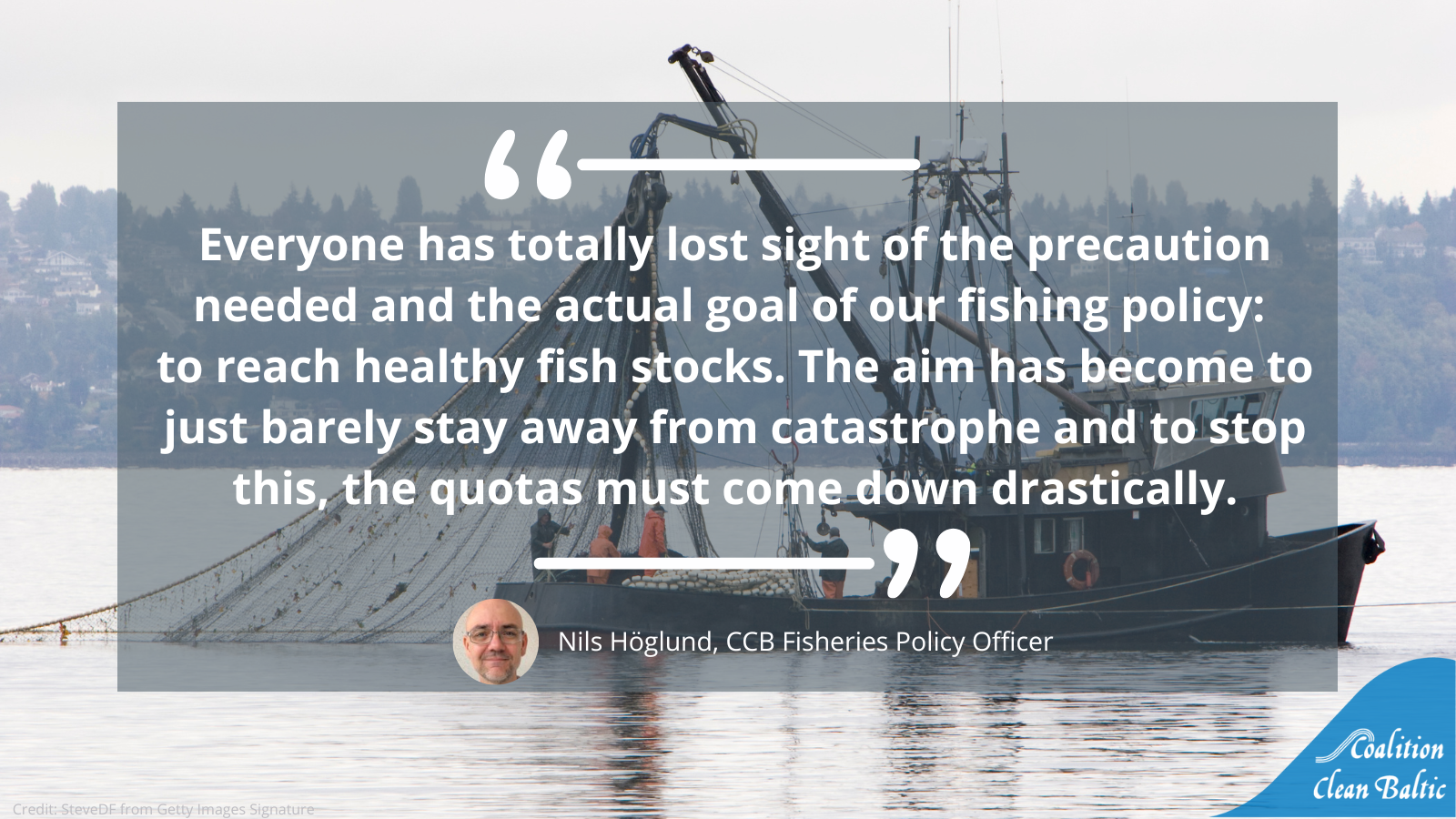
The sad reality is that there is no herring along the coasts, and coastal fishermen have just about given up. The scientists have again produced advice on stocks that are far from stable in numbers and size. This time even the experts indicate that they do not trust in their own models and data”, says Nils Höglund, Fisheries Policy Officer at Coalition Clean Baltic (CCB) - “Everyone has totally lost sight of the precaution needed and the actual goal of our fishing policy: to reach healthy fish stocks. The aim has become to just barely stay away from catastrophe and to stop this, the quotas must come down drastically”.


The scientific advice from ICES released today shows that most stocks are not recovering or are even declining further. Cod and western herring have been at historically low levels for several years now but now sprat has joined this somber list. The catch advice for this year is nearly 20% lower than last year. This is of high concern as sprat are a vital food source for many seabirds, large fish and marine mammals, species that are already under severe pressure in the Baltic Sea.


This depressing conclusion on the new advice has to be that managers simply have not done enough to help some of these stocks recover”, says Lina Birgersson, project coordinator at FishSec - “In some cases we even see them trying to reduce the few legal safeguards we have so they can continue to allow fishing even when the scientific analysis shows these stocks to be in an unhealthy state, this is not ecosystem based management, this is fishing down the food web”.


"The critical situation for the Baltic Sea demands immediate action. The latest ICES data confirms that key species like sprat, cod, and herring continue to face critically low population levels, threatening the entire marine ecosystem. This year’s EU negotiations aren’t just routine — they are a crucial opportunity to redefine our approach and implement quotas that will allow these stocks to recover. It’s time to act decisively to preserve the Baltic Sea for future generations," says Konrad Stralka, CEO of BalticWaters.


For both cod stocks in the Baltic, the situation remains critical and with no sign of improvement even though no fishing for Eastern cod has been allowed in the past three years. ICES indicates that catches of western cod along the German, Danish and Swedish coasts need to be reduced and advises a maximum of only 24 tonnes in total, comprising both commercial bycatch and catches by recreational anglers. This affects other stocks too, in particular plaice. Even though the ICES advice notes that more plaice can be fished in the Baltic Sea this is problematic since plaice is mainly caught with bottom trawling gear which can have high levels of cod as bycatch. ICES states in the advice that: “there are gears available that successfully reduce cod bycatches in the flatfish fisheries; however, these active gears are not currently in use”.


Despite the closure of the cod fishery, cod is still being caught as by-catch by bottom trawlers fishing after flatfish like plaice. We must reduce cod by-catch by introducing bottom trawl free zones in key cod areas as well as electronic monitoring on trawl boats to stop illegal discarding of cod”, says Cathrine Pedersen Schirmer, Chief Advisor at the Danish Society for Nature Conservation.


Despite the closure of the cod fishery, cod is still being caught as bycatch by bottom trawlers fishing after flatfish like plaice. We must reduce cod bycatch by introducing bottom trawl free zones in key cod areas as well as introduce mandatory electronic monitoring on trawl boats to stop illegal discarding of cod”, says Cathrine Pedersen Schirmer, Chief Advisor at the Danish Society for Nature Conservation.


In 2013 the EU reformed its fisheries policy promising a new era with healthy fish stocks. Since then, the fish biomass in the Baltic has declined by around 800.000 tonnes while catches have shrunk by 130.000 tonnes (40% from the closed cod fishery). Implementing the ICES advice will not bring our stocks back. Coastal fishermen are clear: cut the quotas and restrict the trawl fishery for herring, sprat and plaice", says Christian Tsangarides, Baltic & North Sea Coordinator at Low Impact Fishers of Europe, LIFE.


END


***

Coalition Clean Baltic (CCB) – Is a politically independent, non-profit association, which unites 27 NGOs, with over 1 500 000 members in all countries around the Baltic Sea. The main goal of CCB is to promote the protection and improvement of the Baltic Sea environment and its natural resources for present and future generations. More info at: www.ccb.se 


FishSec – Is a politically independent non-profit organisation. We are dedicated to the protection and restoration of marine ecosystem services, with a focus on fisheries. www.fishsec.org 


Danish Society for Nature Conservation – It is a membership based environmental organisation that works to conserve nature and the environment in Denmark through local work, conservation, lobbying and specific projects. www.dn.dk 


BalticWaters – Is an independent foundation engaged in efforts to improve the Baltic Sea environment. The foundation conducts large-scale environmental projects with focus on action-oriented measures and applied research to show which measures can contribute to a healthier sea and viable fish stocks. More about BalticWaters at: https://balticwaters.org 


Low Impact Fishers of Europe (LIFE Platform) – is an EU-wide platform of associations of small-scale fishers committed to fishing in a low impact manner while maximising their socio-economic impact. Small-scale fishing is part of the solution, and LIFE’s mission is to unite small-scale fishers to achieve fair fisheries, healthy seas and vibrant communities. More about LIFE at: https://lifeplatform.eu 


CONTACT
Nils Höglund: nils.hoglund@ccb.s

Lina Birgersson: lina.birgersson@fishsec.org

Konrad Stralka: konrad.stralka@balticwaters.org

Cathrine Pedersen Schirmer: cathrine@dn.dk

Christian Tsangarides: bans@lifeplatform.eu, +46 76 405 6675


[1] LINKS TO ADVICE:


By CCB March 30, 2026
Brussels, 30 March 2026 - Today, Fisheries Ministers from EU Member States meet with the European Commission for the AGRIFISH Council. On this occasion, Oceana, BLOOM, ClientEarth, Coalition Clean Baltic (CCB), Environmental Justice Foundation (EJF), Seas At Risk and WWF EU, handed a symbolic ''Pandora’s Box'' to the EU Commissioner Costas Kadis, sending a clear message as the European Commission prepares its 2026 evaluation of the Common Fisheries Policy (CFP). The box represents the risks of revising EU’s main fishery policy framework: once opened, competing demands from Member States, industry, small-scale fishers, and coastal communities could quickly spiral into division, regulatory delays and uncertainties. This would put at risk the hard-won progress made in restoring Europe’s fish populations and improving the profitability of the fishing sector. NGOs urge decision makers to build on the progress made to date and to prioritise the full and timely implementation of the existing rules. Reopening the CFP and its related provisions would undermine ocean health and the long-term future of Europe’s fishing communities. '' Europe's fisheries policy is facing a credibility test. The law is already there. The tools to rebuild our seas already exist. What's missing is the political will to deliver. Overfishing should have ended by 2020 at the latest. Reopening the CFP would signal that missed deadlines carry no consequences, erode trust, revert the progress made, and put the future of our fisheries and coastal communities at stake ’’, said the NGO coalition. *** Oceana: Vera Coelho, Executive Director and Vice President in Europe BLOOM: Claire Nouvian, Founder and General Director ClientEarth: John Condon, Lead of Marine Ecosystems Coalition Clean Baltic (CCB): Ida Carlén, Co-Chair Environmental Justice Foundation: Steve Trent, CEO/Founder Seas At Risk: Dr Monica Verbeek, Executive Director WWF EU: Ester Asin, Director
By CCB March 10, 2026
Uppsala, March 2026 - CCB has closely worked with the implementation of the EU Marine Strategy Framework Directive (MSFD) ever since its adoption and welcomed the opportunity to give feedback to this crucial directive for marine biodiversity and ocean health through the EU Call of Evidence . Evaluations conducted by the EU Commission previously found many positive effects for EU marine waters stemming from the directive, but also that the directive has some shortcomings. CCB however, maintains that the largest obstacle to fully implementing the directive and achieving Good Environmental Status (GES) is the lack of political will among Member States to do so. This forthcoming revision must therefore result in a framework directive that is more easily enforceable, measurable and implementable, accompanied by sufficient funding to carry out the measures. Furthermore, in order to achieve GES as fast as possible other key pieces of EU legislation must also support reaching it and focus on achieving the goals of the MSFD in their objectives. Seeing that European seas generally are in poor condition and under mounting pressure from human activities and that in the Baltic Sea the situation is especially dire there is an urgent need for truly ecosystem-based management of our seas and for reaching GES. The revised MSFD can help us achieve this, but only if it includes the points outlined below and the directive is fully and swiftly implemented: *** [Short version]*** Operationalise the overarching GES goal: EU sea areas were supposed to reach GES already in 2020, but due to low political ambition, sadly did not do so. Member States should therefore strive to reach GES as fast as possible now. Setting a new overall deadline for when to reach GES is not the answer on how to achieve this goal most efficiently, instead tools that address pressures and measure progress and ensure actual, timely implementation of ambitious measures must be included in the revised directive in order to operationalise achieving the overall GES goal. CCB therefore recommends making the existing and forthcoming threshold values for the descriptors and their criteria legally binding and part of the main directive. Improving regional coordination and implementation: To improve the coherence, coordination and effectiveness of MSFD implementation, assessment of GES, monitoring and the national PoMs the role of the Regional Seas Conventions (RSCs) must be clarified. CCB would welcome collating all the national PoMs into one regional PoM for the Baltic Sea, which should be aligned with, in addition to reaching the goals of the MSFD, with achieving the goals of the Baltic Sea Action Plan (BSAP). Land-sea interface: For the Baltic Sea to achieve GES it is key that land-based pressures, primarily nutrient runoff from agriculture causing severe eutrophication, is also addressed and that implementation of the MSFD goes hand in hand with the implementation of the Water Framework Directive (WFD). The goals of the MSFD and achieving GES should also be included when implementing and shaping the Common Agricultural Policy (CAP), as well as any synergies with implementing the EU Zero Pollution Action Plan which are also important to identify and utilise. The Baltic Sea also has a too high prevalence and level of other pollutants and hazardous substances affecting marine life. Fisheries and aquaculture: As one of the main pressure factors on the marine environment in general, as well as in the Baltic Sea, fisheries and aquaculture and the effects they have on the marine ecosystem and its biodiversity must be addressed in order to achieve GES. This is especially crucial when considering the MSFD descriptor for Biodiversity (D1), Fish and Shellfish (D3), Food webs (D4) and the one for Seabed integrity (D6). Climate change: Climate change is also affecting the Baltic Sea faster than other marine regions and must be factored in when managing the sea area and its resources to ensure EBM and the full implementation of the MSFD and achieving GES. The effects of the climate crisis should be accounted for when setting pressure reduction targets and threshold values for the descriptors and their criteria, in a way that when an effect cannot be measured nor predicted the precautionary principle must be used. Revising Art. 14 of the MSFD: Article 14 in the MSFD outlines the acceptable exceptions when reaching GES is not possible. The article needs to be revised in the forthcoming revision, since it contains too many and too broad in scope possibilities for exemptions (e.g. in Art. 14(4)), which jeopardise the implementation and fulfilment of the directive as a whole. A possible way of modifying it would be to introduce an obligation for Member States to demonstrate that they have taken all measures within their control nationally and that they have tried to address the problem and advance solving it on a regional level through cooperating with other Member States, before they can apply for a possible exemption. Make the Programme of Measures contain ambitious & concrete measures: One of the cornerstones of the MSFD is the national PoMs that are published every six years and are precluded by an assessment of GES in national waters and a monitoring programme. Unfortunately, the current approach to PoMs where Member States freely can choose measures has led to an overall too low level of ambition in the PoMs, and to large differences within regions and between neighboring countries in terms of which measures are included. In order to fully implement the directive and to achieve GES it is of paramount importance that the national PoMs have a high level of ambition and contain concrete, implementable measures and that there is regional coordination. Easing the reporting burden: One of the results from the evaluation of the MSFD was that the current reporting burden is considered to be too high and a possible way to address this is to align the reporting obligations of the MSFD to more reassemble those of the WFD, that has a more simplified 6-year cycle compared to the MSFD. The implementation cycle however should not be revised or at least not in a way that delays reaching GES. Improve coherence with other legislation: To ensure that the revised MSFD is fully implemented it is essential that coherence with other relevant legislation is improved. The MSPD (foundation for the forthcoming Ocean Act) is also currently being revised and to reach the goals for both the directives achieving GES needs to be a cornerstone of the Ocean Act. This is the only way to deliver truly ecosystem-based management of our seas, and the revision of both directives should therefore be coordinated and focused on achieving GES. CCB looks forward to continuing to provide input to the revision process of the MSFD as well as working with the implementation of the MSFD, especially in the Baltic Sea. CCB expects that the revision will result in a more enforceable directive that leads to the fast implementation of ambitious measures to improve the state of the Baltic and European Sea areas and to the achievement of GES. The full text of the submission is available here . *** Links to supplemental documents supporting our positions: CCB’s submission to the Call for Evidence for the Ocean Act Guiding Recommendations for Source-to-Sea Restoration in Riverine, Coastal, and Marine Ecosystems (Coalition Clean Baltic, 2025) Position Paper on Marine Protected Areas (Coalition Clean Baltic 2024) Don’t sink the Common Fisheries Policy – fulfil its potential (joint NGO Briefing 2025) Blue Manifesto (joint NGO paper)