Try to have a conversation in a noisy bar – that‘s the situation a whale is constantly living in
Underwater noise – an issue that is more dangerous for marine animals that we might think
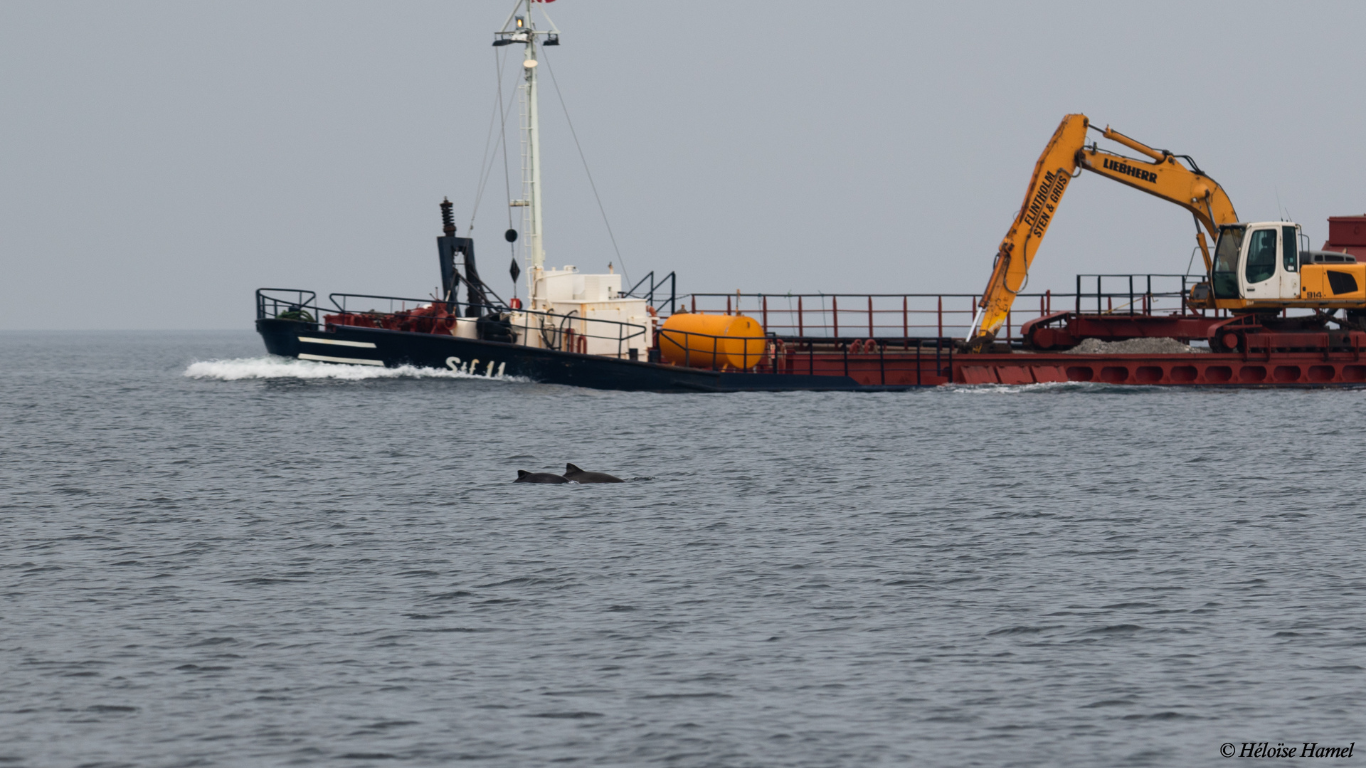
30 June 2022 - At the United Nations Ocean Conference 2022, Coalition Clean Baltic (CCB), altogether with Ocean Care and BUND – Friends of the Earth Germany organized the
side event “Reduce Ocean Noise & Save Our Ocean”, which was the only event focused on such topic and brought a hall full of listeners. The event started by listening the recordings of the harbor porpoise sounds and the noise of only one bigger ship passing by – the audience could evaluate how loud it sounds and how it spreads under the water.
Marine animals “cannot shut the window”
The Representative from the German Environmental Agency and Former Chair of HELCOM, Lilian Busse, made the opening speech drawing the attention to the updated Baltic Sea Action Plan (BSAP), which has more than 200 actions set to achieve a ‘good environmental status’ in the Baltic Sea and 9 of them are meant to minimize the issue of underwater noise.
“This is the easy problem, because when you end noise pollution – it stops immediately. As you know, it is not the same with hazardous substances or plastic pollution”- stressed Lilian Busse.
Bettina Taylor, from the organization BUND - Friends of the Earth Germany, explained why we need to reduce underwater noise.
“We know very well, how noise affects us. We cannot concentrate or sleep when there is noise. Underwater noise comes either from shipping, or from big underwater explosions, seismic surveys that are made to explore ocean floor in the search of oil and gas - then it’s called impulsive noise. In the 1990s, a researcher did an experiment by putting a loud acoustic device in the Southern Indian Ocean: the sound spread around the world to the East coasts of South and North America so as to the coasts of Australia,” – said Bettina Taylor.
She noted that marine animals cannot shut the window when it is noisy – they simply cannot escape that. The noise can disturb an animal – but it also poses a risk of dying if or, for example, an animal is so stressed out that it stops hunting. Moreover, noise underwater accumulates, different sounds strengthens the effect of one another.
Bettina Taylor urged to act to reduce underwater noise, as there is already enough scientific data to prove that is a threat to marine animals. She proposed to ban seismic surveys completely because – “when we phase out coal, there is no need to explore for new deposits of gas and oil“.
150 species are affected by underwater noise
Afterwards, Sharon Livermore, Program Officer at IFAW (International Fund for Animal Welfare) talked about how dangerous for marine animals is noise caused by shipping.
The propeller of the ship and the water movement (air bubbles) usually causes noise. In recent years, global underwater noise has risen by 20 decibels. “The noise spreads easily, especially through cold water environments and at the moment it dominates the background noise” – said S. Livermore.
This noise is stronger and dominates the sounds that marine animals receive and spread by themselves: to locate, to find a mate, to hunt, to feed their calves. That is why underwater noise poses a threat not only to individual animals, but to entire populations.
“A study showed that between 1992 and 2012 the number of ships travelling across the oceans grew by 60%” – noted S. Livermore. – If we count only the Indian Ocean, it’s a 300 % increase in ship traffic. The reason why shipping has increased in this way, it’s the growth of international trade. But we must understand that with increased shipping traffic, air pollution, water pollution and noise pollution rise altogether.”
Approximately, 150 marine species are affected by underwater noise, causing increased stress and behavioural changes. The most acoustically sensitive species are whales, dolphins and porpoises. Underwater noise can affect feeding behaviour, as well as their movements and the level of stress in these animals.
„Remember trying to have a conversation in a noisy bar. We all know how difficult it is. We have to raise our voice to be heard and we can barely hear ourselves. This is the constant life of a whale. Sound is their primary sense – if they cannot detect a mate, it has a negative impact for the population“ – noted S. Livermore.
The easiest solution – to reduce the speed of large ships
Whales have the so called ‚acoustic bubble‘ around them. It‘s the area from which they can receive their sounds or be heard themselves. Some studies in the North Atlantic Ocean have shown that the acoustic bubble of the whales had shrunk exponentially after the industrialization of the Ocean.
Another example was the researches made after the 9/11 events in the United States of America, when all the shippings near the coast of New York coast stopped after the terrorist attack for security reasons. Marine scientists used this opportunity and found out that the amount of stress related to hormones in whales decreased sharply during this period.
„This cannot be explained by anything else: shipping causes biological response (stress hormones) in whales“ – noted S. Livermore. As underwater noise can spread long distances, an international law is needed to address this problem.
„There are immediate solutions that could be approved very quickly – such as reducing the speed of ships by 10%. If we can reduce the speed of the ships – we could reach a 40% reduction of their noise” – said S. Livermore. She added that this measure could also help to reduce ship collisions with whales and greenhouse gas emissions – so it’s three benefits for the environment from just one solution. More complex solutions can be changing the technical features and the design of the new ships to make them more silent.
First area where changes can be adopted – corridor for migration in the Mediterranean Sea
Another speaker at the event, the representative from the OceanCare organization, Carlos Bravo, talked about the area-based noise reduction measures, which were already implemented in one of the coasts in Spain, in the Medittereanean Sea.
“In recent years there were many oil and gas projects started in the Spanish Mediterranean waters. But after the opposition of the private sector, the civil society and non-governmental organizations, stressing the harm to the environment and the negative impact for climate change, the Spanish government banned the search of any new oil and gas fields” – said C. Bravo.
After this success, migration corridor, meant for penguins and other species, was created near the coast of Catalonia, called a cetacean migration corridor. The area covers 46 000 square kilometres.
Ocean Care communicates with government to limit the speed of ships in this area would no more than 10 knots. C. Bravo hopes that Italy, France, Monaco, and other countries that are situated around the corridor would also adopt this ship speed limitation. Although the threat of impulsive noise by search of oil and gas fields was removed, intense shipping continues, with 24 passenger ferries, travelling from Catalonia and Valencia to the Balearic Islands, plus a great number of cargo ships reaching big ports, such as Barcelona and Valencia.
“Shipping is an important way of transportation, but it absolutely rely on fossil fuels. The report issued by the European Maritime Safety Agency and the European Environmental Agency in September last year showed that underwater noise has doubled in the period from 2014 to 2019. It is an increasing problem. There are, of course, technical measures that can be implemented, but we are promoting the most cost-effective and immediate solution: speed reduction” – explained C. Bravo.
What can be changed? The design of the ship, but not the propeller
The event included also a panel discussion, with Frederik Haag, (IMO), Bev Mackenzie, (BIMCO), Mattias Rust (Swedish Ministry of Infrastructure) and Carlos Bravo (OceanCare).
Bev Mackenzie said that they try to measure the noise, because noise is a form of energy, and ships do not want to lose it. BIMCO is collaborating with the International Maritime Organization (IMO) and is willing to implement the guidelines this organization will set. BIMCO is also looking forward to implement the new design of the newly built ships in order to reduce the noise they make. „But it‘s really hard to change propellers or other technical parts of the existing old ships, so I think we should search for a combination of design changes for new ships and operational measures for the old ones“ – said Bev Mackenzie.
Frederic Haag, representative of International Maritime organization (IMO), said that the measures for noise reduction are not yet implemented in Marine Protected Areas (MPAs), but they could be implemented, when the stakeholders will agree and decide which of the measures would work best. „We rely on shipping to receive our medicines and goods, so we need a measure which is appropriate“ – added Frederic Haag.
Mattias Rust, from the Swedish Ministry of Infrastructure was honest: the underwater noise issue is on the agenda of HELCOM and the European Commission, but for the Ministers of EU countries it still has to reach a higher level of urgency, there is a need for more data provided, showing the severe harms for marine animals.
„Our members are willing to support such measures, applied internationally. National regulations are challenging for shipping: ships don‘t necessarily keep the same routes, don‘t always have the same crew. We unite 60% of the cargo ships, but if the rest of the ships will not follow the new rules because it’s cheaper, the problem will not be solved”, - said Bev Mackenzie from BIMCO.
Underwater noise – measures are almost ready, but we also need awareness raising
So why the measure of reduction of the speed cannot be approved immediately?
Frederic Hag explained that when they are trying to make a new rule globally, it takes longer than one could expect. But as IMO is now reviewing the guidelines for ships, it’s easy to take this “one step further”, although that it is beneficial both for environment and economically.
„Shipping industry is a commercial activity. And in my last meetings I‘ve learned that even when they want to adopt various green initiatives and they offer them for their clients, clients do not buy it. That‘s why I think we must invest more in awareness raising“ – added M. Rust.
***
Article written by
Inga Labutytė-Atkočaitienė, Lithuanian Fund for Nature and CCB Communication Group Coordinator
Extra resources
- CCB´s dedicated webpage:
The Baltic proper harbour porpoise
- CCB´s petition #SaveTheBalticPorpoise (2022-23)
- Research Business implications in underwater noise pollution in the Baltic Sea & noise reduction (2022)
- Paper Underwater noise - The neglected threat to marine life (2020)
- BUND´s campaign on underwater noise (2021)
- CCB & BUND Online workshop "Why we should make more noise about underwater noise" (2021)